Using a Child-Led Approach

The 3C Process

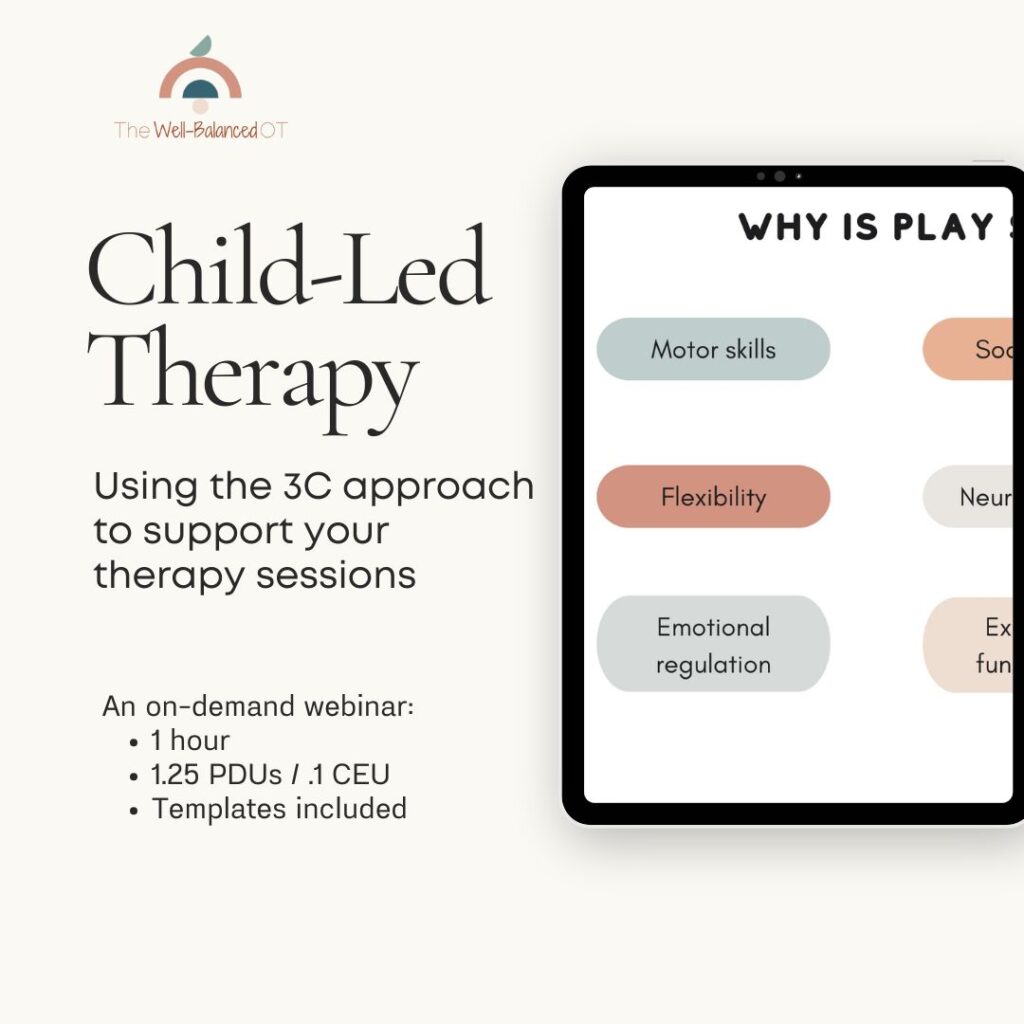
Join this 60-minute course to learn how to transform your practice. We’re no longer spending hours to perfectly plan your OT session. We’re using a child-led approach to not only save time, but allow the child to engage in meaningful, preferred play routines all while working towards goal achievement.


  • 60-minutes
  • On-Demand
  • 1.25 PDU
This course gave me so much hope and relief as a therapist! It provided so much more structure to how to implement child-led therapy without feeling like I’m trying to implement “free play”. I completed the course during an opening in my schedule and was immediately inspired to implement the 3 C’s in my next session!
 

Mykah, OTP

Tell Me You've Been Here Before...

You spent hours planning the perfect OT session

only to have the child not want to do anything you planned.

And then what? Instead of adapting, I find that most therapists spiral into a state of dysregulation themselves. They panic that the parent is watching. They look at the clock wondering how to fill the next 30 minutes. They start wondering if they are even a good therapist.


The perfectly planned session doesn’t exist when working with kids.


We have to be flexible.

We have to adapt.

We have to be child-led.

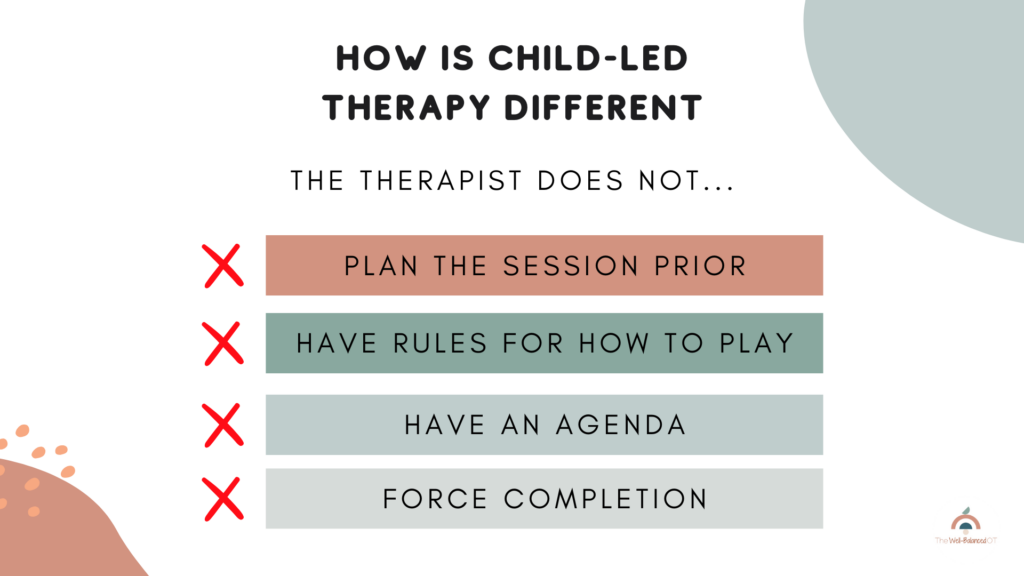
Being child-led means the therapist is able to make a child’s preferred play therapeutic. They can follow the child’s direction while incorporating the child’s goals.


This isn’t easy. This may not feel natural immediately.


But in my opinion, is the best way to work on goals while connecting with the child during activities that are motivating and child-driven.

The 3C process will help you feel more confident using a child-led approach in your therapy sessions.


The 3C process breaks down how to use a child-led approach effectively.


Step 1: Create. This is what we do before our session that helps us prepare a safe environment where the child can explore and gain skills…all while having fun and making choices.


Step 2: Collaborate. This is what we do during our session with the client to work on their goals, without having pre-planned each activity.


Step 3: Critique. What we do after the session to analyze and support the child’s goal achievement, our role in the session, and identify any elements that need problem-solving.

What's included:

  • A 1-hour on-demand webinar
  • 4 months of access
  • Opportunity to submit questions
  • Certificate of Completion for 1 hour
    • This will be provided after the completion of the quiz and survey

After this webinar, participants will


  • Identify the responsibilities of the therapist and client in a child-led session

  • Identify 6 skills that are addressed through facilitating a child-led session

  • Learn how to set up the environment to foster safety, exploration, and skill attainment

  • Will identify 5 signs of dysregulation through non-verbal communication

  • Review cues vs. prompts to support a child-led session

  • Identify 6 questions for self analysis to improve child-led sessions

Who is the Webinar for?

Pediatric OTPs or therapy students who:

  • Want to spend less time and effort meticulously planning their pediatric sessions

  • Want to feel more confident letting a child lead

  • Feel like child-led sessions are frequently chaotic

  • want to expand their treatment approaches to meet the needs of their clients

Who is the Webinar for?

Pediatric OTPs or therapy students who:

  • Want to spend less time and effort meticulously planning their pediatric sessions

  • Want to feel more confident letting a child lead

  • Feel like child-led sessions are frequently chaotic

  • want to expand their treatment approaches to meet the needs of their clients

Testimonials

Half Circle

I liked the case studies; gave some good, practical tips that I immediately used!

OTP

This is a great course that gives the basics of child-led play. I think this is the most up to date knowledge to support best practice for our clients, especially the neurodiverse population.

Jessica, OTP

Great examples of how to put this in practice. It made me think about how I need to brainstorm all of the activities I could do with a few items in the room to help me feel more prepared.

Annie, OTP

Frequently Asked Questions

You’ve got questions. We’ve got answers. 

You can if you’re looking for ways to promote a more child-led structure to your play sessions at home, or in other therapy practices.

The information provided will still be valuable and applicable to other professions and parents!

Yes! But let’s dive into that for a second.

A CEU and a PDU are both units towards your license/certification, but they are measured differently.

1 contact hour = 1 PDU or .1 CEU

1 contact hour with an assessment = 1.25 PDUs for NBCOT

1 PDU = .1 CEUs

These units can typically be applied to your state license and NBCOT. If you are not an OT please check your professional requirements.

This course will provide you 4.375 PDUs for NBCOT after completion of the program and quiz. That is the equivalent of .35 CEUS.

NBCOT no longer requires AOTA pre-approval for the max amount of PDUs per hour, they just require an assessment!
I do not offer refunds since all information and resources are available immediately after purchase.

Yes! There is a question box under the webinar video where you can post any questions you may have and Katie will respond.

This webinar is directed at the pediatric population, with tips and strategies from infancy through childhood (high school).

You get lifetime access to this webinar. That means there’s no rush to complete it in the next 2 months. Take your time.

Katie on a swing outside

About Your Host

I’m Katie, a pediatric Occupational Therapist and founder of The Well-Balanced OT, an educational platform for therapists and parents.


Over the last 11 years, I have gained extensive experience in Sensory Integration, Feeding, and Reflex Integration. You can learn more about my experience and education here. 


I currently live in Massachusetts with my husband, a ton of house plants, and closets full of crafts. 

Child-led doesn’t mean unstructured.

It means you’re skilled enough to follow the child and still hold the therapeutic thread without forcing, bribing, or clinging to a plan that isn’t working.


If you’re ready to stop feeling like child-led sessions are chaotic and start feeling like they’re intentional, regulated, and goal-driven, this training was made for you.


Get instant access to the webinar, handouts, and critique tools today