
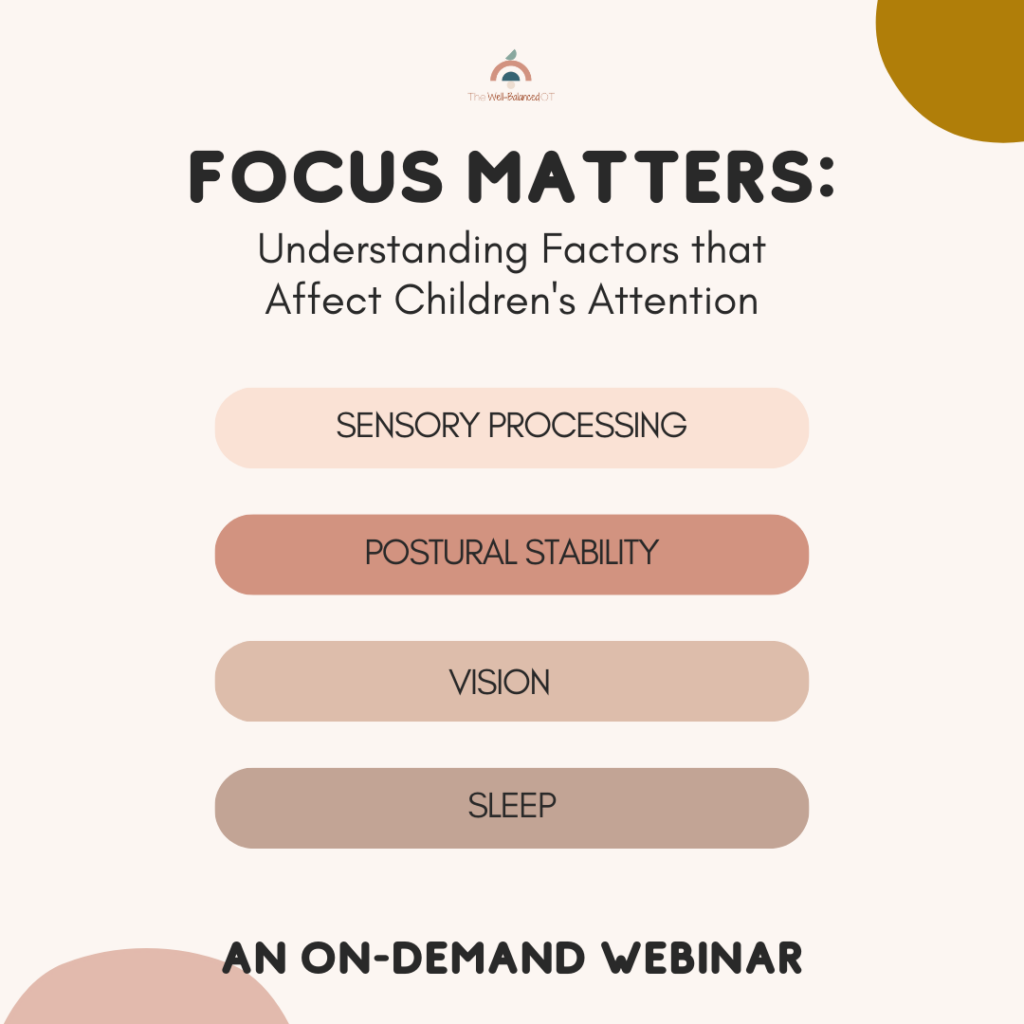
Focus Matters
Understanding Underlying Factors that Affect Children's Attention
In this on-demand webinar, we will take a closer look at the various factors that can impact our children’s ability to focus and maintain attention. Some of the key areas we will explore include sensory processing, postural stability, vision, and sleep. Perfect for therapists, parents, family members, and teachers!
Improving attention no longer means...
- being the perfect listener and demonstrating a quiet body (ewww).
- setting goals based on non-preferred tasks (just, why?)
- forcing a child to stay at the table in hopes of improving their attention span (please don’t ever do this)
None of these approaches work well, and they aren’t very neurodiversity-affirming.
I loved the presentation on the underlying sensory needs to support attention. The categorizing of the information and visuals presented in the material helped me process the information well. This course; paired with the Motor planning and praxis course you have support such a great base of foundational knowledge to treat motor planning and attention deficits. thank you for this course.
Megan, OTP
Every brain processes sensory information differently, and some people have a harder time than others. Whether it’s too much stimulation or not enough, it can be a real challenge to stay focused. In this course, we’ll help you understand how their sensory systems are impacting attention and what strategies we can use to improve focus.
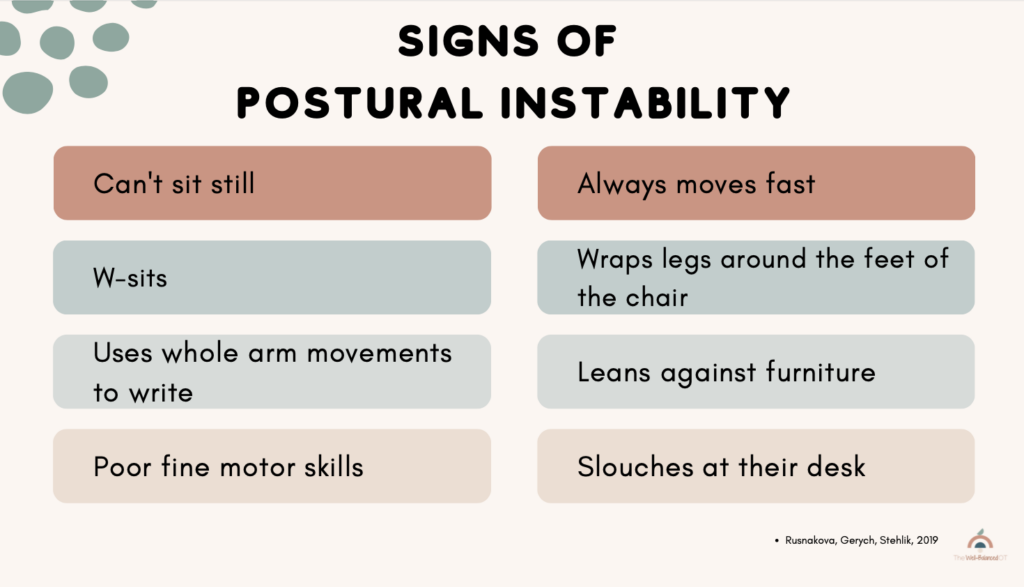
Postural stability is an often-overlooked factor that can impact attention. I can’t tell you how many times I’ve seen therapists recommend a yoga ball for a child who is fidgety in hopes that it would improve attention. For some kids who need more vestibular input, it might work great, but often not for those with poor postural stability. Let’s learn how to identify the difference, assess for challenges, and figure out what supports might work best for these kids.
How can we pay attention if we can’t visually focus on something in front of us? Or if the world was blurry? Or if we lost focus every time our head moved the slightest amount? None of us would be able to pay attention! Learn how the visual system and the vestibular systems work together, how to assess for ocular-motor skills, and fun activities to ultimately help our kids attend.
Research has consistently shown that individuals who do not get enough sleep may struggle with attention and focus throughout the day. We will discuss theimportance of good sleep hygiene and share tips for improving sleep quality to support better attention and focus.
I loved this webinar! Many of thing subsections I knew in this course already and were a good refresher. And some areas I had no idea about but was thinking of the clients I treat and how it could be beneficial along the way! I feel like I can describe attention better to my parents in evaluations and how teachers may think there’s attention deficits when it could be unrelated.
OTP
Webinar Modules
Section 1: What is Attention?
- Breaking down the stigma around what attention should look like
- Neurodiversity affirming resources to support attention
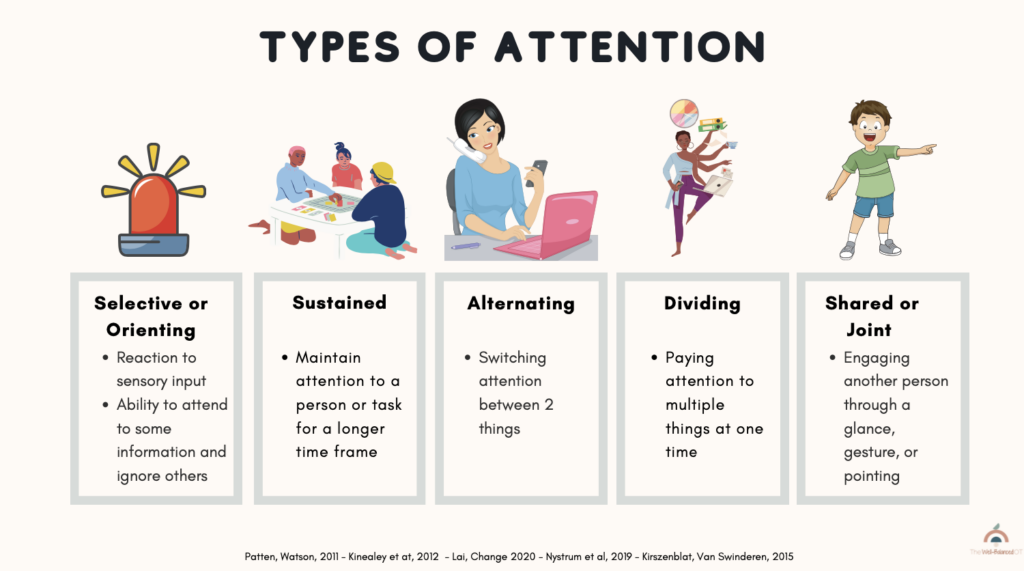
- 5 types of attention
Section 2: Sensory Processing
- How our sensory systems impact attention
- A breakdown of sensory processing
- Sensory assessments
- Modulation Presentations and Supports
Section 3: Postural Stability
What is Postural stability and how does it impact attention?
- Signs
- Assessment
- Common Challenges
- Adapted Seating
- Treatment Strategies
Section 4: Vision
- Eyesight vs. vision
- Vision and the vestibular system
- Signs of dysfunction
- Ocular Motor Skills
- Assessment
- Assessing PRN
- Treatment Recommendations
Section 5: Sleep
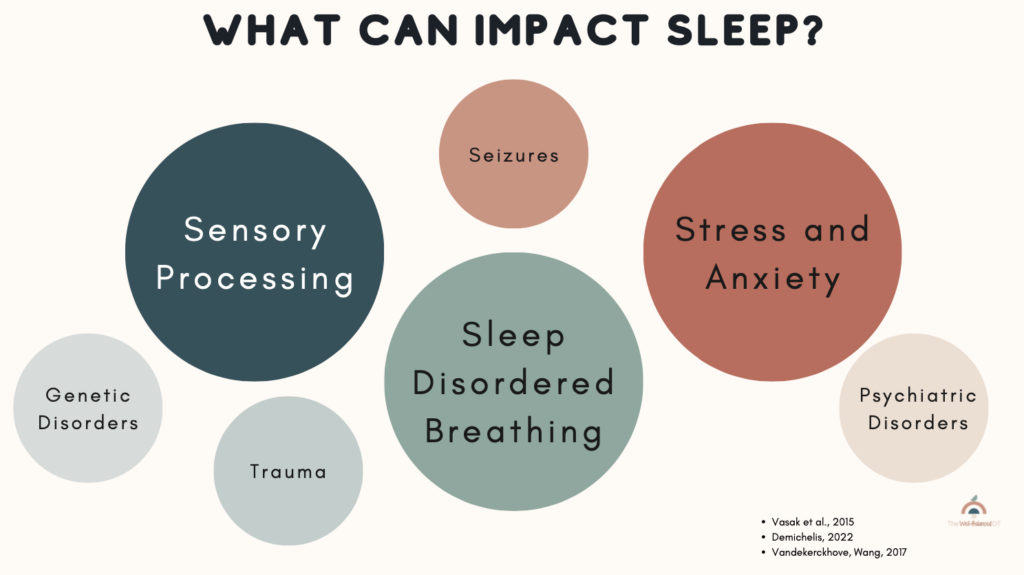
- How Sleep impacts Attention
- Sensory processing and sleep
- Sleep Disordered Breathing
- Supporting Sleep Routines
Section 6: Do's and Don'ts
- Tips
- Goal writing
You'll Learn:
- How to identify new ways of thinking about what attention looks like
- How sensory processing, postural stability, vision, and sleep impact attention and learning
- To identify multiple strategies to modify the environment to improve focus
- How to assess for ocular motor skills
- How to assess postural stability using clinical observations
- Treatment strategies to improve underlying challenges impacting attention
- Examples of how to write good attention goals

Who is the Webinar for?
- Pediatric Therapists who want to feel more confident in their knowledge and ability to assess and treat Motor Planning challenges. This is a beginner/Intermediate level webinar.
- Parents and family members who want to support their children but don’t know where to start
- Teachers, Students, and other therapists who want more knowledge about how motor planning challenges may be impacting their students/clients

Who is the Webinar for?
- Pediatric Therapists who want to find new ways to support inattention, have better assessment skills, and identify
- Parents and family who want to learn more about possible reasons why their child is having trouble focusing and how to get the support they need.
- Teachers who want to learn more about supporting their classrooms focus and attention.
The Masterclass will include:
A 3-hour on-demand webinar
Lifetime access to the webinar and resources
Certificate of Completion for 3 contact hours (given after completion of quiz and survey)
This will count for 3.75 PDUS for NBCOT after quiz completion
This is equivalent to .3 CEUS
Resources:
Evaluation templates/guides
Activity list
Testimonials

Wow – game changer. Understanding what impacts attention opens up so many ways to help my child (and honestly everyone!). As a parent it empowered me to have more useful conversations with our OT and helped me translate the why behind school-based accommodations in easy-to-understand language for teachers who have enough on their plate!
Parent

I have learnt so much from completing this course! I have already started implementing some of the assessments and I am picking up on new things in my observations, such as when a child is squinting or rubbing their eyes during an activity. I feel like I can help my service user’s and their families even better now that I have completed this PD. Thank you!
Ella, OTP

This course helped me look at attention in a whole different light. Katie’s extensive knowledge of how the sensory systems, along with other factors, work together to influence attention has given me new ideas and strategies to use in my practice.
OTP

This was a great course with an opportunity to utilize the information immediately. Wonderful activity examples as well as goal writing examples.
Audrey, OTP

I loved this course! It was full of information but never felt overwhelming or hard to digest. It was broken up in a way that made it easy to stay focused and soak up all of the information.
Shea, OTP
As an OT and a parent of child with attention difficulties, I found this webinar extremely helpful. I have begun implementing several strategies with my son and have already seen big improvements.
Rylie, OTP
Frequently Asked Questions
You’ve got questions. We’ve got answers.
Yes! This webinar is open to all! It will provide the foundational education for those that are coming in without any knowledge so that we are all on the same page. The treatment section will also provide you with tons of tips on how to better support these kids at home and in school!
One of the most amazing things about the platform we use to host this program is that you are able to ask questions under each of the videos. If you have any questions, please ask – I am happy to answer!
Yes! But let’s dive into that for a second.
A CEU and a PDU are both units towards your license/certification, but they are measured differently.
1 contact hour = 1 PDU or .1 CEU
1 contact hour with an assessment = 1.25 PDUs for NBCOT
1 PDU = .1 CEUs
These units can typically be applied to your state license and NBCOT. If you are not an OT please check your professional requirements.
This course will provide you 4.375 PDUs for NBCOT after completion of the program and quiz. That is the equivalent of .35 CEUS.
NBCOT no longer requires AOTA pre-approval for the max amount of PDUs per hour, they just require an assessment!
I do not offer refunds since all information and resources are available immediately after purchase.
This webinar can be beneficial to take whether you are a new therapist, or have been practicing for years!
This will give you solid knowledge, evaluation tools, and treatment strategies to utilize in your sessions.
I try to explain things in a way that anyone could understand them!
This webinar is directed at the pediatric population, with tips and strategies from infancy through childhood (high school).
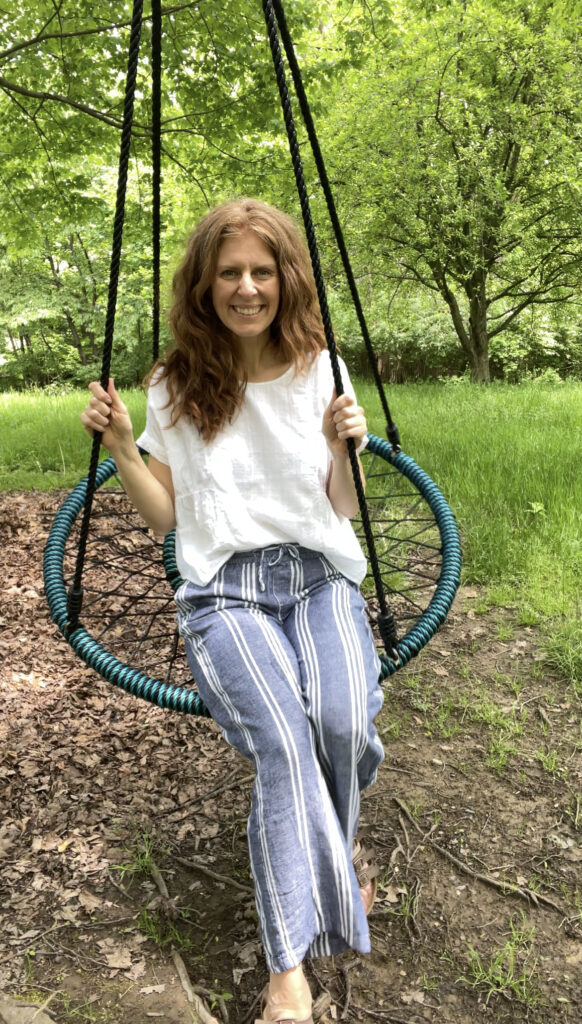
About Your Host
I’m Katie, a pediatric Occupational Therapist and founder of The Well-Balanced OT, an educational platform for therapists and parents.
Over the last 11 years, I have gained extensive experience in Sensory Integration, Feeding, and Reflex Integration. You can learn more about my experience and education here.
I currently live in Massachusetts with my husband, a ton of house plants, and closets full of crafts.
If you've made it all the way down here, you're ready...
to feel more confident in identifying, assessing, and supporting motor planning challenges!
You’ll walk away with a clearer understanding of praxis and practical strategies you can begin using immediately.